
Mimi came over to see the boys off to school so we could head to the hospital early.
Earlier in the week, our appointments were confirmed. We would see the social worker, urology nurse, neurology nurse, occupational therapy, physiatrist, and some others. We also found out that her renal ultrasound (we have one almost every clinic appointment) was scheduled for 3 p.m. From the outset, it looked like it was going to be a long day.
Once we got to the hospital, got checked in, and started the process of answering what feels like 1000 questions about the last six months of Esther-Faith's life, we got word that there was a cancellation in ultrasound and Esther-Faith was going to have her renal ultrasound at 9 a.m. instead of 3 p.m.
Sigh of relief.
BIG.
So, 30 minutes from her (new) appointment, we pushed fluids. She needed a full bladder to get good scans.

Some folks who we were not scheduled to see stopped in for social visits or just to catch up. One of those people was Brett--the wheelchair tech. Not only is he AWESOME at his job, he is also just a great guy. We shared books we've been reading. Our goals for Esther-Faith. She shared how much faster she wants to go. So, Brett went to his car and got an ultra-light, multi-purpose (can be used for every day or racing) PINK wheelchair for Esther-Faith to try. It did not have a seatbelt or tippers.
She loved it. L.O.V.E.D it.
Here she shows off her wheelie skills for Brett.

While Brett retrieved the fancy, new wheelchair, Esther-Faith and I headed to ultrasound.

The ultrasound tech was SUPER, VERYMUCH, ULTRA thorough. Don't get me wrong, I appreciate thorough. But seriously, they're not allowed to tell us anything, Tim was waiting back in the clinic room, and the minutes were dragging into an hour. Picture after picture after picture. Not by me, after the first couple of minutes, I forgot I had the camera. I just stared at the black and white screen-- not completely ignorant of what I was looking at, but still more confused than sure. I asked annoying questions. (I know, because she kind of rolled her eyes at me.) After a (really) long time, she gave me a catheter to empty Esther-Faith's bladder so she could get post-void pictures. Some more time (and lots more pictures) later, we packed up and headed back to Tim.

You'll never guess who was waiting when we got back... NICK!
Nick (who makes her orthotics) is Esther-Faith's favorite person at clinic. She thinks he makes a great dance partner. And in the morning when we were getting ready to go, she said she wanted to see Nick "first and last." In other words, she wasn't willing to fit anyone else into her busy clinic schedule.


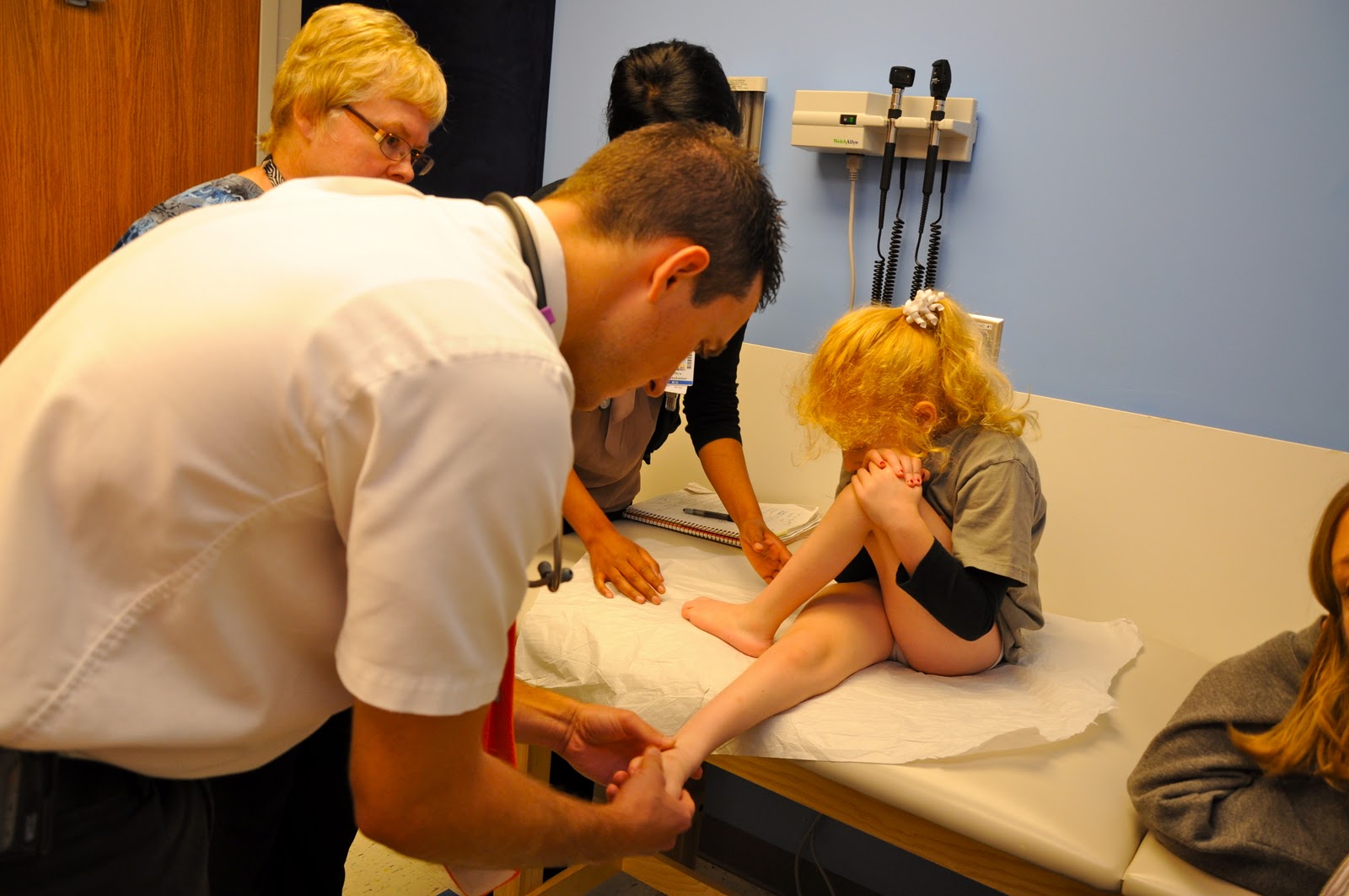
After Nick, we met with the OT, the developmental pediatrician, the neuro-psych doctor, the pediatric resident, the urology nurse, the physiatrist (and her crew), and the neurology nurse. She hid from more than a few of the doctors.
I think one of the reasons Esther-Faith has never met a stranger (and why we're having such a difficult time teaching her stranger-danger) is because of appointments like this. Where there are lots of the same doctors she sees from clinic appointment to clinic appointment, but even MORE that she'll see once in her life, but that we ask her to allow to touch her feet and legs, check her shunt, ask her personal questions, and force her to be polite and accommodating.
I get it, they're learning to be the doctors of tomorrow, but for today, it seems so contradictory to tell her to be wary of strangers--oh but wait, not these ones. Or those ones over there. So, I'm left with questions about how to teach her stranger-danger while learning to trust the right people.


Some good news... and some great news.
The good news first: Esther-Faith will be participating in a clinical trial that will--over the course of a year--test for markers in urine that indicate a serious infection. She will also be testing a new, single-use (but more expensive) hydrophilic catheter for the duration of the year to determine if the incidence of UTIs goes down. Her catheters will be supplied (yay) and she'll have her urine tested periodically. We're all about finding new products that will help other SB patients!
The GREAT news: After talking to the neurology nurse about her symptoms, undergoing some simple tests, and understanding better what we're dealing with, the neurology nurse said that Esther-Faith is NOT experiencing increased tethering of her spinal cord! All SB patients have some tethering (it's the nature of the beast), and some will require de-tethering surgery and some will not. Currently, we are in the WILL NOT category! (Can I get a whoop-whoop?!)
Things can change fast or slow, and we're still learning, but even though it was one of the longest clinic appointments yet, we walked away with eight prescriptions, an appointment for followup testing with neuro-psych, an appointment for wheelchair clinic, and a script for an eight-week OT session, but feeling positive and reassured! (If not a little apprehensive about a racing wheelchair!)
After a quick lunch out, we took Esther-Faith to her favorite destination (Build-a-Bear) for a new friend: SNOOPY.

